
What Happened to the Learning Objective?
 Learning objectives have always been important. As young instructional designers, we were taught to define objectives to ensure we know what a learner should be able to do after training. They provide a common understanding among learners, instructors, designers, developers, and organizations about the intended outcomes of training. Without clear objectives, it’s difficult to determine whether learning has been successful or whether the training itself was effective.
With the rise of rapid development authoring tools, non-learning professionals were suddenly able to create visually appealing content without relying on an instructional designer or developer. With subject matter experts (SMEs) able to develop content independently, the volume of online content being developed skyrocketed. Designers had long relied on SMEs for discovery, identification of resources, guidance and quality control in content development. When this partnership became less formal, the focus on learning objectives diminished. At the same time, most authoring tools did not provide a good way to define objectives.
Is this SME-developed learning content bad? Absolutely not, it just became more difficult to establish metes and bounds for development. Does the content teach the information the student needs, or does it risk making a deep dive into technical minutia important to the SME that does not impact what a student needs to do on the job? It’s important that we don’t lose sight of developing and delivering an efficient and effective learning experience. Measuring our value based on the volume of training content is counter-productive and often results in training that does not support business goals.
Why are Learning Objectives Important?
Objectives Provide Direction.

Learning objectives serve as the roadmap for a course or training program. They help provide a target for learners that designers and instructors can use select what content and activities should be incorporated into training by asking questions like:
- What knowledge do learners need to gain?
- What skills should learners be able to demonstrate?
- What behaviors are we trying to change?
Objectives Align Training with Business Goals
Organizations invest in training to improve performance, not simply to deliver content. Well-written objectives connect learning to measurable organizational outcomes. This alignment helps justify training spend and can provide a measure for return on investment.
For example:
| Business Goal | Learning Objective |
| Improve customer satisfaction | Resolve customer complaints using the approved escalation process. |
| Reduce safety incidents | Demonstrate proper work permitting procedures before servicing equipment. |
| Increase sales | Recommend the appropriate product based on customer needs. |
Objectives Drive Assessments
 Objectives define what should be measured. If a course objective is “Configure a firewall according to company policy,” then the assessment should require learners to configure a firewall—not simply answer multiple-choice questions about firewalls. Without objectives, assessments may test information that isn’t relevant to the desired outcome.
Objectives Improve Learner Motivation
Learners are more engaged when they understand what they are expected to accomplish. Clear objectives reduce uncertainty and help learners focus their efforts.
Consider the difference between these two statements:
- “Complete this cybersecurity course.”
- “By the end of this course, you will be able to identify phishing emails, report suspicious activity, and protect sensitive company data.”
The second statement provides a clearer purpose.
Objectives Help Enable Competency-Based Learning
Modern learning ecosystems focus on competencies and skills rather than course completion. Learning objectives serve as the bridge between instruction and competency achievement.
In this model, objectives support the assessment results used as evidence of a competency or credential. Organizations can use this information to build work teams with the right skills for a job and design targeted, personalized interventions to improve employee skills.
The Role of Objectives in xAPI, cmi5, and the Total Learning Architecture
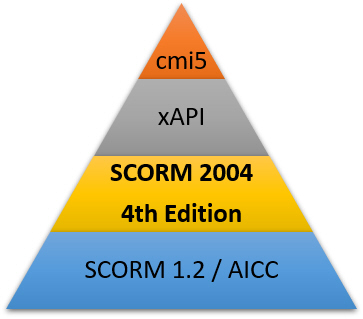 Although xAPI does not prescribe how objectives are defined, it enables their use. The ability is inherited by the cmi5 profile for Content-LMS interoperability. cmi5 focuses on tracking learning experiences using xAPI. Because xAPI is highly extensible, including information like associated objectives or even competencies achieved through training and validated through an assessment.
cmi5 content, called assignable units, has a defined course structure to support interoperability of content from one LMS to another. Part of this course structure includes the Course Title, Description and Objectives allowing content creators to tie specific activities within a course back to the Objectives they support. Including these objectives, in the context of xAPI statements, is the first best practice listed in the cmi5 GitHub site.
The Total Learning Architecture (TLA) takes a broader, encompassing view of an integrated, data driven learning ecosystem that can track a student’s performance across all learning and real-work activities. Instead of locking data into a company learning management system, school records, Human Resources Information Systems, and competency management systems, the TLA seeks to integrate these systems using xAPI and robust Learning Metadata. This makes consistent data, using xAPI and a mature governance model critical but also opens the door to allow more advanced learning as personalized training and spaced reinforcement while providing a clear view of a learner’s abilities.
Looking Ahead
As organizations shift from tracking course completion to tracking workforce capability, learning objectives are evolving reusable, machine-readable building blocks that connect learning, assessment, competencies, credentials, and job performance. Standards such as xAPI make it possible to capture evidence of learning wherever it occurs, while systems built around competencies use that evidence to recognize and develop workforce skills.
In short, learning objectives remain the foundation of effective learning because they answer the most important question: What should someone be able to do after learning that they couldn’t reliably do before? Everything else—content, assessments, analytics, competencies, and credentials—builds on that foundation. Continue reading about objectives in xAPI here.

Mr. Welder’s career is founded in traditional instructional design and computer-based training development. He is a certified Development Dimensions International facilitator, a Kirkpatrick Certified Evaluator and facilitator of the Ohio State University curriculum development program. In addition to working in industry, Mr. Welder has held adjunct faculty positions at Bowling Green State University, Ohio and the College of the Mainland, Texas. Mr. Welder has been published in both Training Magazine as well as US Business Review.